
Blog
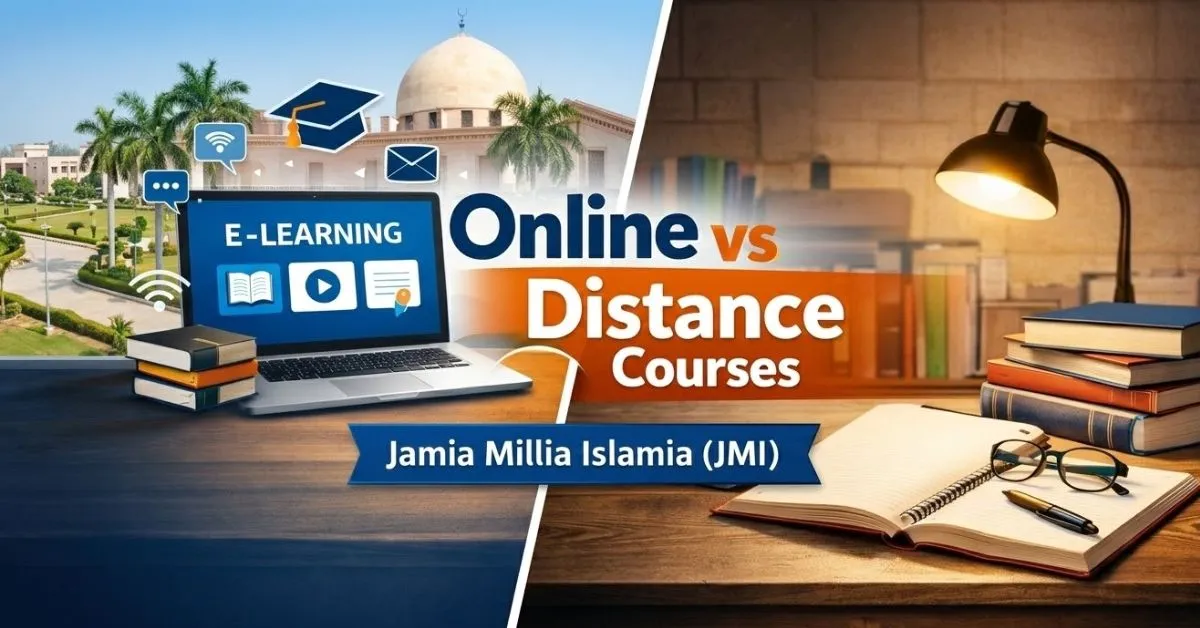
What Is the Difference Between Online and Distance Courses at Jamia Millia Islamia (JMI)?
Jamia Millia Islamia (JMI) is one of India’s most renowned central universities, located in New Delhi. Since its inception in 1920, it has been recognized as one of India’s top universities, offering world-renowned courses in arts, science, engineering, law, and management, among other disciplines.
Today, Jamia Millia Islamia has embraced the digital age by introducing online and distance learning programs. These innovative learning models have made higher education accessible to millions of students across India who, due to employment, relocation, responsibilities, or other similar reasons, are unable to participate in traditional, on-campus learning options.
However, many students are unaware of the difference between online and distance learning courses at JMI. While both allow you to learn without the need to travel to the physical campus daily, online courses and distance courses differ in terms of delivery methods, level of interaction, technical requirements, learning styles, etc. This blog aims to provide all the necessary information about the differences between online and distance courses at JMI, so that you can make an informed decision about the best option based on your expectations, personal routine, and learning style.
Overview of JMI Online Courses
JMI online courses are fully online degree programs conducted via a web-based learning management system (LMS) or portal. Through the JMI online courses, students attend live online lectures and discussions, review recorded classes, submit assignments electronically, and communicate with instructors online all from the convenience of their homes.
Features of JMI Online Courses:
- Live virtual lectures through video conferencing platform.
- Interactive digital material such as video lectures, e-books, quizzes.
- Frequent faculty interaction through discussions board, email, live Q and A.
- Submission of assignments and projects online.
- Proctored online exams.
- UGC-DEB approved degree programs that can match that of regular university degree programs.
Eligibility for JMI Online Courses
To be eligible for the courses offered through JMI Online, each course has different eligibility requirements. Generally, if you want to enroll in an undergraduate course, you must have a 10+2 certificate, and for a postgraduate course, you must be a graduate. In some cases, you are expected to have knowledge in a specific stream, and in others, a certain minimum percentage is required.
- Popular JMI Online Courses:
- MB A (Master of Business Administration)
- MA in English/Urdu/History
- BA (Bachelor of Arts)
- Certificates and Diplomas in Various Subjects
- Post Graduate Diploma in Computer Applications (PGDCA)
Online Course Mode:
For these courses, students will mostly study online through the JMI Online portal. Classes will be live-streamed and attendance can be monitored. All material will be online. All students enrolled in JMI online courses will need an internet connection, a laptop/tablet/mobile phone, and that’s all.
Overview of JMI Distance Courses
JMI distance course programs are developed and implemented by the Centre for Distance and Open Learning (CDOL) at Jamia Millia Islamia Distance Education. Courses follow a common open learning system, where study materials are sent in printed or digital format, and students pursue their studies at their own pace with minimal on-campus interaction.
Significant Features of JMI Distance Courses:
- Study at your own pace with printed or digital materials.
- Daily attendance is not required.
- Occasional contact sessions are offered (optional for many courses).
- Term-end exams will be conducted at an examination center.
- UGC-DEB approved, and the degree is nationally recognized.
- Less infrastructure is required, and high-speed internet is not required.
Eligibility Criteria for JMI Distance Courses:
Like online courses, eligibility criteria will be program-specific. At least a 10+2 qualification is required for undergraduate programs and a relevant graduate degree for postgraduate programs. Working professionals, homemakers, and students living in remote areas are typically the most common candidates for these courses.
Popular distance courses at JMI:
- BA in various subjects
- MA in Political Science, History, Urdu, and Hindi
- BCom
- Diploma in Mass Communication
- Certificate courses in Arabic/French/Persian languages.
Medium of Study – Distance Courses:
Students receive self-instructional material (SIM) in print or digital form and are expected to study on their own and then appear for term-end exams. In some programs, students also attend contact classes/personal counseling sessions at the study center.
Key Differences Between JMI Online and Distance Courses
Before enrolling in online and distance courses at JMI, it’s important to understand the differences between them. Here’s a detailed comparison:
| Parameter | JMI Online Courses | JMI Distance Courses |
|---|---|---|
| Mode of Learning | Fully digital — live classes via LMS/portal | Self-study via printed/digital study materials |
| Faculty Interaction | Regular via video, chat, forums | Limited — mainly during contact classes or exams |
| Assessment | Online quizzes, assignments, proctored exams | Term-end exams at designated centres |
| Flexibility | High — access content anytime, anywhere | Moderate — self-paced but exam-bound schedule |
| Infrastructure Needed | Laptop/smartphone + internet | Minimal — printed materials suffice |
| Cost | Moderate to high (tech-driven) | Generally lower (print-based) |
| Peer Interaction | Virtual discussion forums & group projects | Very limited, mostly independent study |
| Recognition | UGC-DEB approved; equivalent to regular degrees | UGC-DEB approved; equivalent to regular degrees |
| Target Audience | Working professionals, tech-savvy learners | Students in remote areas, self-paced learners |
In fact, online courses at JMI are more structured, interactive and technology-driven, while distance courses offer more freedom with minimal digital infrastructure requirements.
Pros and Cons of JMI Online and Distance Courses
| Online Courses | Distance Courses | |
|---|---|---|
| Pros | Join real-time discussions with faculty, adjust to flexible schedules, benefit from on-demand access to learning materials, get instant answers to your questions, and network with a diverse group of students from around the world. | Low cost, offline usage, easy speeds, great for areas where internet is not easily available, and no tech overload. |
| Cons | These things will be required: a stable internet connection, higher costs, strong self-control, and screen fatigue may occur. | Limited faculty interaction, less engaging format, isolated learning experience, and limited real-time feedback. |
Both formats have their advantages. Which one you choose depends on your technology, your financial budget, how you learn best, and your career aspirations.
Which One Should You Choose?
Choose an online course if you have:
- Attend classes and exams according to a given schedule, either in person or online (as part of a synchronous delivery model)
- Learn via the internet (on a smartphone or computer)
- Actively interact and communicate with faculty and other students (e.g., through chats or forums)
- A more technological and interactive approach to learning
- Specializations such as management, IT, communications, etc., that involve collaboration
For example: Rahul works as a junior bank executive in Bengaluru and wants to complete his MBA, but is stressed about his current job. Therefore, he chooses JMI’s online MBA course, for example, because weekend live classes help him stay disciplined in his studies.
Choose a distance course if you have:
- Poor internet access in your location
- Choose your own speed and method of study
- Study while juggling household chores
- Completing a distance course using traditional textbooks and taking exams at a center (e.g., a distance MA program in Hindi)
- Studying arts, humanities, languages, etc., for which distance learning methods may be more suitable
For example: Priya is a homemaker and wants to pursue an MA in Hindi, but lacks proper internet access. Therefore, she enrolls in a distance MA in Hindi offered by JMI. She must purchase printed materials and take exams at her local (distance learning center).
Career Opportunities After JMI Online and Distance Courses
Both online and distance degrees from JMI are recognized by UGC-DEB and they are similar to full-time degrees in the sense that both are equivalent. Therefore, if you opt for any of the above mentioned online or distance degrees, you will be qualified for government jobs, jobs in the private sector and also for further studies.
Career prospects after online courses from JMI:
- MBA degree holders can take up jobs in the fields of banking, marketing, HR, and finance.
- MA degree holders can take up jobs in journalism, content writing, academics, public administration.
- PGDCA degree holders can apply for job roles like IT support, data entry, software companies.
- Certificate holders can take up certificate based jobs and even utilize the degree for promotions.
Career prospects after distance courses from JMI:
- B.A. and B.Com degree holders are eligible for appearing in government competitive examinations such as UPSC, SSC, State PSCs etc.
- Language certificate holders will be able to take up a job like translator, language teacher, cultural coordinator.
- Mass Communication diploma holders can take up a job like media house, PR agency, digital marketer.
- MA degree holders will be eligible to appear for NET/JRF and enter academic careers.
Irrespective of whether you choose to study online or in distance mode, having a degree from JMI is valuable. Employers all over the country respect JMI as a premier central university, and both online and distance degrees are of the same value.
Conclusion
How are online and distance courses at JMI different? The answer lies in technology, interaction, and learning. Online courses are perfect for learners who seek digitally interactive and structured learning, while distance courses are for self-starters who prefer a flexible and technology-free experience.
Best of all, these programs lead to UGC-approved and nationally recognized degrees offered by one of India’s top central universities. Whether you’re considering a JMI online course or a JMI distance course, you’re definitely investing in a quality education that will greatly help you in your career.
Still wondering what to choose? Check out the JMI website or contact CDOL directly to learn about the current courses offered by the university, their fees, and admissions.
Make a smart decision today, because the right path to education is one that fits not only your dreams but also your life. Check out JMI Online Courses and JMI Distance Courses to find the right fit for your online vs distance learning education in India.
Frequently Asked Questions
How are JMI online courses different from JMI distance education?
JMI online courses are entirely technology-driven, featuring live/recorded sessions and assessments based on internet access. JMI Distance Education, which is part of the CDOL (Center for Distance and Open Learning), provides learners with printed self-study materials and sometimes conducts contact sessions. The main difference between online and distance courses is the mode of learning. One relies heavily on technology, while the other follows a print-based model.
What programs does Jamia Millia Islamia offer in distance education?
Under the Center for Distance and Open Learning (CDOL), Jamia Millia Islamia offers a variety of programs, including UG, PG, and diploma programs in Mass Communication, Social Work, Mass Communication, and Computer Applications. If you’re looking for information about JMI distance programs, it’s best to visit the official CDOL portal, cdol.jmi.ac.in, and check the list of programs, which is updated every academic year.
Are JMI online and distance degrees the same?
Yes, both JMI online and distance degrees carry the same academic weight because they are awarded by Jamia Millia Islamia itself – a UGC-recognized central university. Since both have the same legal recognition, there’s no discrimination between JMI distance and online courses. However, you can ask your prospective employer if there are any specific requirements in the relevant sector.
What are the eligibility criteria for JMI distance and online courses?
Eligibility criteria for JMI courses vary depending on the specific program and level. Generally, distance undergraduate programs require completion of 10+2, and distance PG programs require a bachelor’s degree with a specified minimum percentage. Eligibility criteria for JMI online programs will be somewhat similar. Some JMI courses may require an entrance exam to qualify. Before applying, it’s advisable to download the program-specific requirements from the CDOL prospectus or the official JMI portal.
How do fees differ between JMI distance and online courses?
Fees for JMI distance learning programs under CDOL are affordable and will be available in the prospectus for each academic year. Fees for JMI online courses, typically available on the SWAYAM and MOOCs platforms, can be very low or free. Fees for platform-based certificates may differ from official university courses. Check the fee structure for your desired course on the official JMI or CDOL portal.
Is an entrance exam required for JMI distance education?
Mostly, admission to JMI distance learning programs is based on qualifying exam scores; however, some PG courses may require an entrance exam. Admission criteria for JMI courses may depend on the branch and specific requirements. It’s advisable to download the latest CDOL prospectus to determine whether an entrance exam is required or whether admission to your program is merit-based.
Is there any provision for JMI distance education students to enroll in regular JMI programs?
JMI does not allow students to switch between different modes of study, as the admission process and framework for each is completely different. Students pursuing distance programs from JMI who wish to attend classes on campus will need to retake the entrance test as part of the university’s normal admission process. Before making any decisions, check with your relevant department or the CDOL office for definitive guidelines.
How are exams conducted for JMI online and distance courses?
JMI distance education exams are typically held at designated offline examination centers. JMI online course exams can be conducted entirely online (online proctored exams) or at designated offline centers, which vary for each course. The main difference between JMI online and distance courses lies in their examination method – digital evaluation versus offline physical exams. Please confirm this with the relevant department upon admission to the course.
What type of study material is provided in JMI distance versus online courses?
JMI distance education provides students with printed self-study materials (SLMs) along with some contact/counseling sessions. JMI online courses offer digital learning resources such as video lectures, e-books, and interactive content through an LMS (Learning Management System).
Are JMI Distance Education students provided with campus facilities?
JMI Distance Education students are typically not provided with hostel accommodations, as it is designed for off-campus learners. They may have limited access to libraries or facilities, but this will vary; inquire at the CDOL office. Access to campus facilities for both blended and regular JMI online students depends on the specific structure.
Get 100% free counseling